Trumpet Fingering Chart
Learn beginner Bb trumpet notes with an interactive valve guide and free printable trumpet fingering chart PDF.
Select Note
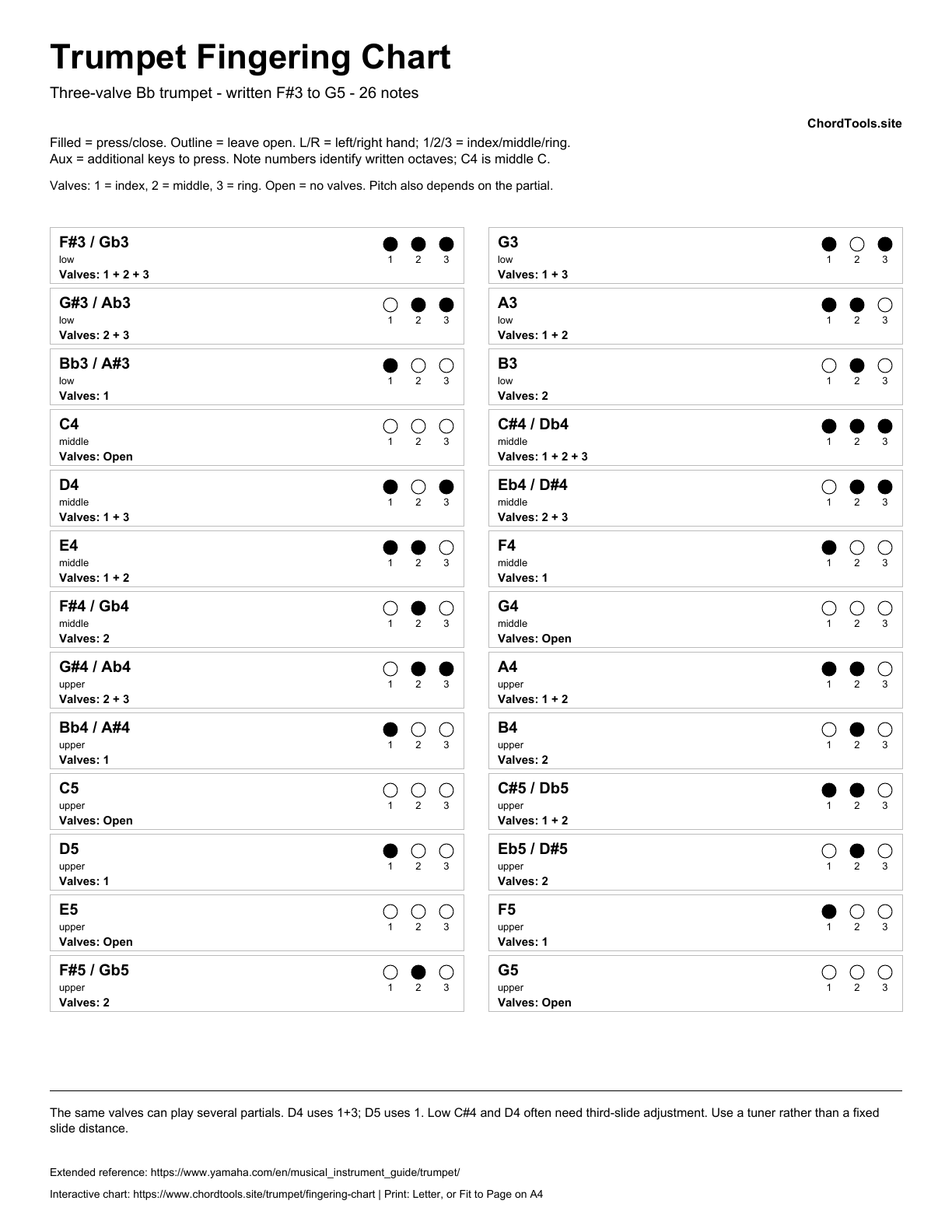
Free Printable Trumpet Fingering Chart PDF
Download a one-page, black-and-white valve chart with 26 chromatic written notes from F#3 through G5. Numbered valves and written-octave labels make it useful for lessons and band folders.
Download PDFHow to Read a Trumpet Fingering Chart
A trumpet fingering chart shows which valves to press for each written note. The numbers 1, 2, and 3 match your index, middle, and ring fingers.
- Filled valves are pressed down.
- Open valves stay up.
- Open means no valves are pressed.
- Some notes have alternate fingerings for tuning, but this beginner chart uses the common standard fingerings.
Tips for Beginners
Start with open C and G, then learn the valve patterns around them. Use steady air, relaxed fingers, and a tuner to check pitch because brass notes can bend sharp or flat even with the correct valves.
PDF Coverage and Printing
The free PDF covers 26 chromatic written notes, F#3 to G5, for three-valve Bb trumpet. It uses the same note patterns as the interactive chart. Filled circles mean pressed keys or closed holes; outlined circles remain open. The diagrams are labeled key schematics, not to-scale pictures of the instrument.
Download the file or open it in your browser and choose Print. The chart is one US Letter page. For A4 paper, use Fit to Page; check the preview before printing. Black filled circles and larger key labels keep the chart readable in grayscale. No sign-up is needed.
The Same Valves Can Play Different Notes
Open C4, G4, C5, E5, and G5 all use no valves, but they are different notes in the harmonic series. A fingering chart cannot tell you which partial your lips are producing. Use the written pitch in your music, listen to a reference note, and check with a tuner. The octave number matters: D4 uses valves 1+3, whereas D5 commonly uses valve 1 alone.
Written Pitch and Bb Trumpet
This chart names written notes for Bb trumpet, not the sounding concert notes. Written C4 sounds concert Bb3. A chromatic tuner in concert-pitch mode will therefore not display C when you play written C. Set its transposition to Bb trumpet or compare against the sounding note. These standard patterns also help with cornet practice, but do not treat the chart as a guide to every alternate fingering or every brass instrument.
Why Low C# and D Often Sound Sharp
Written C#4 uses all three valves and D4 uses valves 1+3. These combinations often need slide adjustment to center the pitch. If your trumpet has a movable third-valve slide, practice using it while checking a tuner; the amount varies with the instrument and player. Do not force a fixed slide distance from a chart. Keep the valves fully depressed, because a half-pressed valve can interrupt the air path.
Practice Valves and Partials Separately
Start with C4-D4-E4-F4-G4, holding each note for four slow beats. Keep your fingers curved and press the valves straight down. Then play open C4-G4-C5 gently to hear how the partial changes without changing valves. Return to the easier notes if the tone becomes strained. Correct valves are only part of a correct note: air, embouchure, hearing, and slide adjustment work together.
Fingering References
Compare the standard patterns and consult these references for alternatives and notes beyond this chart.
Yamaha: trumpet valve fingering referenceCommon Questions
Is this chart for Bb trumpet?
Yes. This page uses common written fingerings for standard Bb trumpet.
What does open mean on trumpet?
Open means you play the note without pressing any valves.
Why can the same valve combination play multiple notes?
Trumpets use the harmonic series. Your air speed and embouchure choose the partial, while the valves lengthen the tubing.
Are there alternate trumpet fingerings?
Yes. Advanced players use alternate fingerings for tuning, trills, and technical passages.