Clarinet Fingering Chart
Learn beginner Bb clarinet notes with an interactive Boehm-system guide and free printable clarinet fingering chart PDF.
Select Note
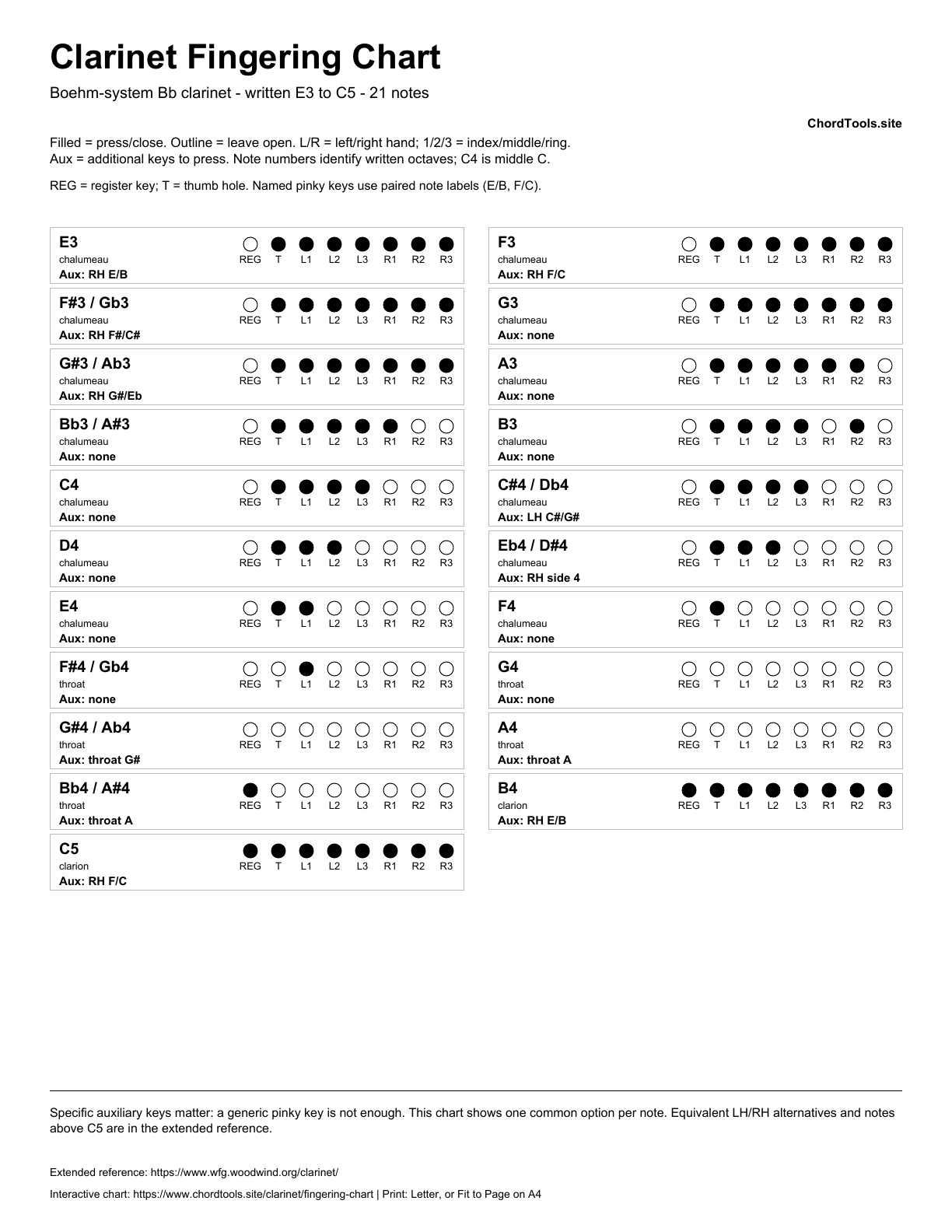
Free Printable Clarinet Fingering Chart PDF
Download a one-page, black-and-white Boehm-system chart with 21 chromatic written notes from E3 to C5. Main-hole diagrams and named auxiliary keys distinguish low, throat, and early clarion notes.
Download PDFHow to Read a Clarinet Fingering Chart
A clarinet fingering chart shows which holes or keys are closed for each written note. This chart uses a compact Boehm-system layout for beginner Bb clarinet.
- Filled circles mean the key or hole is closed.
- Open circles mean the key or hole stays open.
- Reg means the register key. It is used for clarion-register notes.
- Auxiliary labels name the specific pinky, throat, or side key. RH means right hand; LH means left hand.
Tips for Beginners
Start slowly and seal each tone hole fully before adding speed. Clarinet notes can squeak if the register key is bumped, if fingers leak air, or if the reed is not vibrating freely.
PDF Coverage and Printing
The free PDF covers 21 chromatic written notes, E3 to C5, for Boehm-system Bb clarinet. It uses the same note patterns as the interactive chart. Filled circles mean pressed keys or closed holes; outlined circles remain open. The diagrams are labeled key schematics, not to-scale pictures of the instrument.
Download the file or open it in your browser and choose Print. The chart is one US Letter page. For A4 paper, use Fit to Page; check the preview before printing. Black filled circles and larger key labels keep the chart readable in grayscale. No sign-up is needed.
Find the Right Register
Octave numbers distinguish notes that share a letter name. Low E3 uses the thumb hole, all six main finger holes, and the E/B pinky key. E4 uses the thumb and left index finger only. G4 is open, while low G3 closes the thumb and all six main holes. The chart reaches the first two clarion notes, B4 and C5. It does not include the full clarion or altissimo range, or German/Oehler-system fingerings.
Which Pinky Key Should You Press?
The auxiliary labels identify specific keys, not a single generic pinky key. RH E/B means the right-hand key used for low E3 and clarion B4. RH F/C is used for F3 and C5; RH F#/C# and RH G#/Eb serve the corresponding lower notes. LH C#/G# is the left-hand key used for C#4. Several notes have equivalent left- and right-hand pinky options. Choose an alternate to avoid sliding the same pinky between adjacent keys.
Throat Notes and Crossing the Break
F#4 uses the left index finger with the thumb hole open, G4 has no main holes closed, G#4 uses the throat G# key, and A4 uses the throat A key. Bb4 combines the throat A and register keys. To move from Bb4 to B4, close the thumb and all six main holes, add the E/B key, and keep the register key pressed. Practice that change slowly: a partially covered hole is a common reason the upper note squeaks.
Check a Fingering Without Rushing
Begin with E4-D4-C4-D4-E4, keeping the thumb hole covered and moving only the left-hand fingers that change. Then compare low G3 with D5 using a complete reference chart: the register key raises this lower pattern by a twelfth, not an octave. For the notes included here, try E3-B4 and F3-C5 only when the low notes speak reliably. Use a teacher's help for reed, embouchure, and instrument-seal problems.
Fingering References
Compare the standard patterns and consult these references for alternatives and notes beyond this chart.
Woodwind Fingering Guide: Boehm chalumeau and throat notesWoodwind Fingering Guide: clarion notes and pinky alternativesCommon Questions
Is this chart for Bb clarinet?
Yes. It is written for standard Bb clarinet using common Boehm-system beginner fingerings.
What does Reg mean?
Reg means register key. Pressing it helps the clarinet speak in the clarion register.
Why do some clarinet notes have alternate fingerings?
Alternate fingerings help with tuning, trills, technical passages, and different clarinet models.
Is this a full altissimo chart?
No. It covers written E3 through C5, including throat notes and the first two clarion notes. Full clarion and altissimo fingerings require an extended chart.